Quick Summary
Electrical repair in the Treasure Valley covers fixing wiring, breakers, outlets, and panel faults, while HVAC repair covers air conditioning and furnace problems. Burning smells, warm outlets, and frequent breaker trips are warning signs that need a licensed electrician. Air conditioning and furnace issues should be diagnosed separately, since cooling and heating fail for different reasons.
- Burning odors, hot or discolored outlets, and buzzing panels signal a safety risk requiring prompt action.
- Repeated breaker trips usually indicate a fault that needs investigation, not repeated resetting.
- Opening the panel, adding circuits, or replacing breakers requires a licensed electrician.
- Spring is the right time to prepare the cooling system, and fall the heating system.
- Confirm license number, liability insurance, and a written estimate before hiring a contractor.
Table of Contents
- Which HVAC and Electrical Repair Services Homeowners Commonly Need
- Signs You Need Electrical Repair in Your Home
- Air Conditioning Repair and Furnace Repair: Knowing the Difference
- HVAC Maintenance Checklist for Treasure Valley Seasons
- Repair or Replacement: How to Decide
- What to Check Before Hiring an HVAC or Electrical Company
- Booking Your Next HVAC or Electrical Service Visit
- Frequently Asked Questions
Which HVAC and Electrical Repair Services Homeowners Commonly Need
Last Updated: October 27, 2026
Most Treasure Valley homeowners deal with two systems that fail at the worst possible times: heating and cooling, and the electrical panel and circuits that power everything else. Knowing which repairs are routine and which need a licensed professional saves money and protects your home. M Property Services provides electrical, HVAC, and handyman services under one roof.
The most common HVAC calls involve air conditioning that will not cool, furnaces that short cycle or fail to ignite, thermostats that stop communicating with the system, and airflow problems caused by dirty filters or blocked returns.
Grouping these needs by urgency helps. A furnace that stops producing heat in January is an emergency; a slow-draining bathroom fan is not.
U.S. Department of Energy guide to heating and cooling maintenance
For electrical concerns, note what happened, when, and which circuit or area was affected. To see the handyman services we offer, review our handyman services.
Signs You Need Electrical Repair in Your Home
Electrical problems rarely fix themselves, and some warning signs point to fire or shock risk rather than a nuisance.
Flickering lights that happen only when a large appliance starts often signal an overloaded circuit or loose connection, while lights that dim across the whole house point toward a supply issue that should be inspected promptly.
Treat these signs as a reason to act, not to wait:
- A burning odor coming from an outlet, switch, or panel
- Outlets or switches that are hot to the touch or discolored
- Frequent breaker trips or a breaker that will not reset
- Flickering or dimming lights that are not explained by a single appliance
If you see any of these, avoid using the affected circuit. Contact a licensed electrician to have the problem identified and corrected before it becomes a safety hazard.
What a Licensed Electrician Actually Repairs
Homeowners often ask what falls inside electrical repair versus what requires a full rewire or panel upgrade. Knowing the categories helps you describe the problem accurately when you call.
Common repair categories include:
- Outlet and switch replacement , worn contacts, loose backstab connections, and outlets that no longer grip a plug. Replacing a device is quick; tracing why it failed is the real work.
- Circuit tracing and fault isolation , finding which device, splice, or run of wire is causing a breaker to trip. This is the most time-intensive electrical task and the one homeowners most often skip.
- Breaker replacement , a breaker that is worn, undersized for the load, or no longer trips reliably. Replacing it is straightforward; confirming the circuit and panel can safely carry the load is not.
- GFCI and AFCI protection , installing or replacing ground-fault and arc-fault protection in kitchens, bathrooms, laundry rooms, garages, and bedrooms, where code and safety expectations have tightened over time.
Where the DIY Safety Boundary Sits
Some electrical tasks are reasonable for a careful homeowner: replacing a lamp, resetting a tripped GFCI, swapping a faceplate, or turning off a breaker before working on a fixture.
A practical rule: if the task requires opening the panel cover, identifying a circuit with a multimeter, or making a permanent connection inside a box, stop and call a licensed electrician.
Circuit Breakers That Keep Tripping
A breaker that trips once after a heavy load may simply be doing its job. One that trips repeatedly, or with nothing obviously overloaded, signals a fault that needs investigation.
A useful diagnostic step before you call: unplug everything on the affected circuit and reset the breaker.
The table below summarises the most common electrical repair categories and what each one involves.
| Repair category | What it involves | Key point |
|---|---|---|
| Outlet and switch replacement | Worn contacts and loose connections | Quick to replace; the cause takes longer to trace |
| Circuit tracing and fault isolation | Finding the device or wire causing a trip | Most time-intensive electrical task |
| Breaker replacement | Worn, undersized, or unreliable breakers | Panel and circuit load must be confirmed safe |
| GFCI and AFCI protection | Ground-fault and arc-fault protection | Required in kitchens, bathrooms, and similar areas |
| Panel work | New circuits and failed breakers | Requires a licensed electrician |
| Aluminum wiring remediation | Specialized connectors or pigtails | Reduces fire risk in older homes |
| Dedicated circuits | Separate line for a high-draw appliance | Stops sharing a circuit with general lighting |
Air Conditioning Repair and Furnace Repair: Knowing the Difference
Air conditioning and furnace repair address two separate halves of your comfort system, and symptoms often look similar from the thermostat. Air conditioning repair focuses on cooling: refrigerant levels, the compressor, the outdoor condenser fan, and the indoor evaporator coil. Furnace repair focuses on heat generation: ignition, the burners or heating elements, the heat exchanger, and the blower.
Some issues are shared, such as a clogged filter, a failed blower motor, or a thermostat that sends the wrong signal. Diagnosing the correct half first avoids paying for unnecessary parts.
Running a furnace that will not ignite, or repeatedly restarting a short-cycling system, can damage components and create a carbon monoxide risk on gas units. Turn the system off and call for service.
HVAC Maintenance Checklist for Treasure Valley Seasons
Preventive maintenance is the cheapest way to avoid emergency HVAC calls. Treasure Valley summers push air conditioners hard, while winter cold snaps put heavy demand on furnaces. Scheduling a checkup at the start of each season lets a technician catch wear before it becomes a failure on the hottest or coldest day of the year.
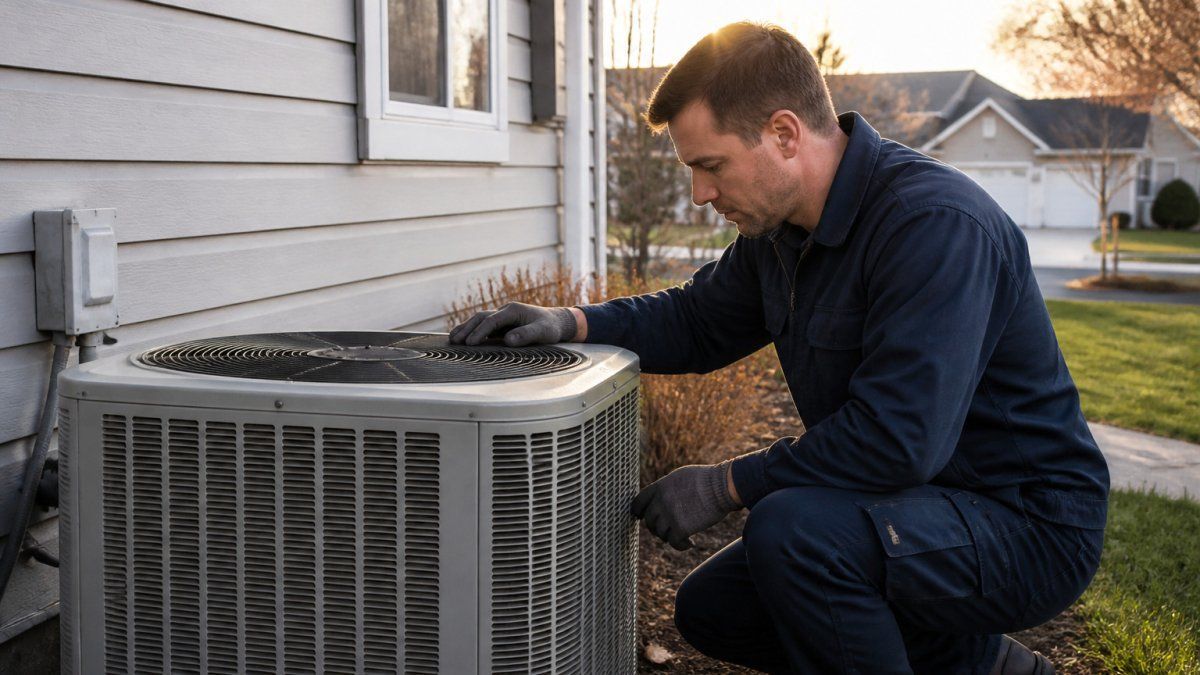
Use this checklist as a starting point:
- Replace or clean the air filter every one to three months, depending on pets and usage
- Clear debris, grass, and leaves from around the outdoor condenser unit
- Check that supply and return vents are open and unblocked
- Inspect the thermostat batteries and confirm the schedule settings
Spring is the right time to prepare the cooling system, and fall the heating system.
Repair or Replacement: How to Decide
Deciding whether to repair or replace an aging system depends on the unit's age, the repair cost relative to the system's value, and how often it has been failing.
Repair tends to make sense when the system is relatively new, the fault is isolated to a single part, and the rest of the equipment is in good condition. Replacement tends to make sense when the heat exchanger is cracked, the refrigerant line is leaking, or energy bills keep climbing because the system is no longer efficient.
What to Check Before Hiring an HVAC or Electrical Company
Hiring the right contractor protects your home and your wallet. Before you book, confirm the company holds the correct state licenses for the trade you need, electrical and HVAC work each require specific credentials. Ask whether the company carries liability insurance and workers' compensation.
A practical verification checklist:
- License number and trade , ask for the license number and confirm it matches the trade being performed. Ask which license covers each task.
- Liability insurance , ask for a current certificate of insurance.
- Workers' compensation , ask whether the company carries it.
- Written estimate , request a written scope naming the parts, the labor, and any warranty on both. Verbal estimates are hard to compare and harder to enforce.
Repair or Replace: A Practical Framework
When a technician recommends replacement, homeowners deserve a framework rather than a sales pitch. Three questions usually settle it:
- How old is the equipment relative to its expected service life? Equipment well past its typical service life and facing a major repair is usually a replacement candidate; mid-life equipment facing a single part failure is usually a repair candidate.
- How does the repair cost compare to replacement? A common rule of thumb is that a repair costing more than half the price of a new system, on equipment past its service life, tilts toward replacement. Ask for both figures in writing.
- How often has it failed? Repeated failures on the same component within a single season are a pattern, not bad luck.
You can learn more about our licensing by contacting us to ask about our credentials.
U.S. Consumer Product Safety Commission home electrical safety resources
Booking Your Next HVAC or Electrical Service Visit
When you are ready to schedule service, a few details speed up the process: the type of system or circuit involved, the symptoms, when they started, and any recent work done on the home. If the issue is an electrical safety concern such as burning odors, sparks, or repeated breaker trips, shut off power to the affected area first and avoid using it until a technician has inspected it.
M Property Services serves homeowners across Ada and Canyon Counties with electrical, HVAC, and handyman services. Contact M Property Services to ask about service.
Frequently Asked Questions
What HVAC and electrical repair services do homeowners commonly need?
Most homeowners call for help with air conditioning that blows warm air, furnaces that short cycle or fail to start, electrical outlets that stop working, and circuit breakers that trip repeatedly. Ask any company whether it holds current licenses for each trade it offers, since HVAC and electrical work are regulated separately. Clear written scope before work begins helps avoid surprises.
How do I know whether my HVAC system needs repair or replacement?
Consider the age of the unit, how often it has needed service in the past few years, and the cost of the most recent repair. Systems that are often in need of repair, or that have aged well beyond their typical service life, may cost less over time to replace. A technician can compare the repair estimate with the cost of a new system and explain how the efficiency of each option affects your utility bills. Get a written estimate for both options before deciding.
What should I do if a circuit breaker keeps tripping?
Turn off the devices on that circuit, reset the breaker, and turn devices back on one at a time to find the source. Repeated tripping can point to an overloaded circuit, a faulty appliance, or wiring damage, and it should not be ignored. Do not replace a breaker with a higher-rated one to stop the tripping, since that can overheat the wiring. Call a licensed electrician if the breaker trips again or feels warm, buzzes, or smells of burning.
Can one company handle both HVAC and electrical repairs?
Some local companies offer both HVAC and electrical services under one contact, which can simplify scheduling and communication for busy households. Confirm that the company holds licenses for each trade it performs. Ask which credentials apply to the work you need.
How often should a home HVAC system be inspected?
Ask a qualified HVAC professional about an inspection schedule for your system.
What should I check before hiring an HVAC or electrical repair company?
Verify the company's license numbers and ask which credentials apply to the work you need.
When is an HVAC or electrical problem an emergency?
Treat any electrical problem that involves burning smells, scorched outlets, sparking, or a hot panel as an emergency, and shut off power to the affected area if it is safe to do so. For HVAC, a furnace or air conditioner that stops working during extreme temperatures can pose a risk to vulnerable people in the home, so prompt service is important.
Keeping your home's electrical and HVAC systems safe and reliable does not have to mean juggling multiple companies. M Property Services brings over 30 years of local experience to every visit, and our licensed technicians handle electrical, HVAC, and handyman work in one call. Reach out today to talk through your home's needs and get dependable, professional service from a team that lives and works in the community you call home.