Which HVAC Filter Types Are Best for Your Home?
A dirty or poorly matched air filter can make a furnace or air conditioner work harder than it should. For Boise-area homeowners and property managers, understanding HVAC filter types is a practical way to protect equipment, manage indoor air quality, and avoid an unnecessary service call during a hot summer or cold winter.
The best filter is not automatically the most expensive one or the one with the highest rating. It must fit your system, capture the particles you care about, and still allow enough airflow for the equipment to operate properly. That balance matters more than marketing claims on the packaging.
HVAC Filter Types and What They Actually Do
Every forced-air heating and cooling system needs a filter. Its first job is to keep dust, lint, and debris from building up on sensitive internal components, especially the blower motor and evaporator coil. Many filters also improve the air circulating through the home by trapping pollen, pet dander, mold spores, and other airborne particles.
Not all filters perform the same way. Material, thickness, and MERV rating all affect how much a filter captures and how much resistance it creates as air moves through the system.
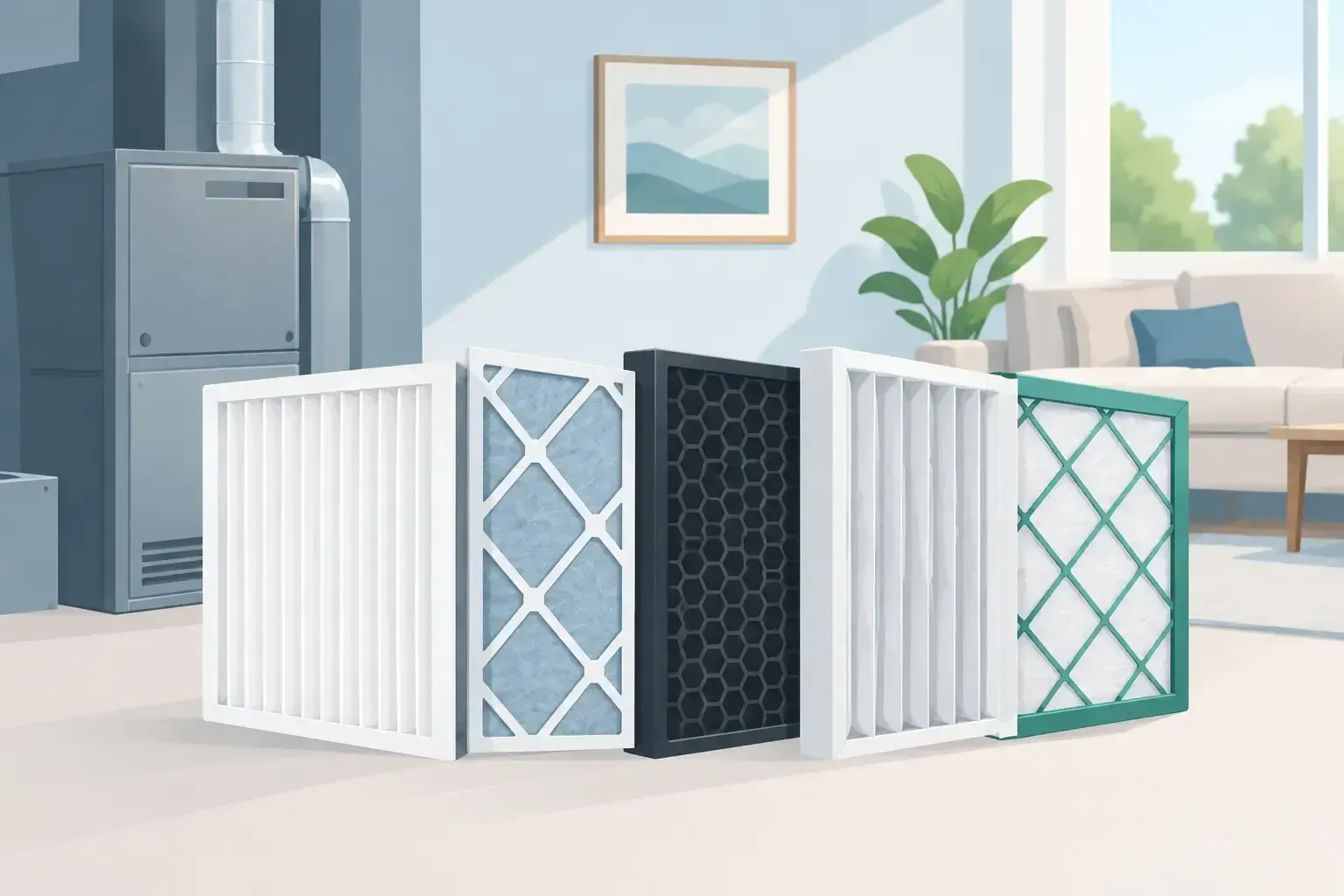
Fiberglass filters
Basic fiberglass filters are usually thin, inexpensive, and easy to find. They are made with loosely woven fiberglass strands and are designed primarily to protect HVAC equipment from larger debris.
Their low resistance to airflow can be helpful for older systems with limited blower capacity. The trade-off is lower particle capture. Fiberglass filters generally do little for fine dust, pollen, pet dander, or smoke particles. They can be a reasonable minimum option for a vacant property, a lightly used system, or equipment that cannot support a denser filter, but they are rarely the best choice for an occupied home.
Pleated filters
Pleated filters are the most common residential option and, for many homes, the most sensible choice. Their folded media creates more surface area than a flat fiberglass filter, allowing them to capture smaller particles without needing to be replaced every few weeks.
They are available in a wide range of ratings, often from MERV 5 through MERV 13. A quality pleated filter with the right rating can reduce household dust and allergens while providing reliable equipment protection. The key phrase is the right rating. A higher-rated filter may capture more, but it also may create more airflow resistance.
Washable or reusable filters
Washable filters are marketed as a lower-waste, long-term alternative to disposable filters. Instead of replacing them, you rinse or vacuum them according to the manufacturer’s instructions, allow them to dry completely, and reinstall them.
The upfront cost can be appealing over time, but performance varies widely. Many reusable filters have lower filtration efficiency than a good pleated disposable filter. They also require consistent maintenance. Putting a damp filter back into the system can encourage moisture problems, and a filter that is only partially cleaned will not perform as intended. For busy households and rental properties, disposable pleated filters are often the simpler and more dependable route.
Electrostatic filters
Electrostatic filters use charged fibers to attract particles. Some are disposable, while others are washable. When clean and properly installed, they can capture a useful amount of dust and airborne debris.
As with reusable filters, the real-world result depends on upkeep and product quality. A washable electrostatic filter that is not cleaned thoroughly can restrict airflow. Before switching to one, confirm that the filter fits the system correctly and that its pressure drop is appropriate for the equipment.
HEPA filters
True HEPA filters capture very fine particles and are common in medical settings, specialized air cleaners, and certain high-performance filtration systems. They are not usually a direct replacement for a standard one-inch furnace filter.
A standard residential HVAC blower often cannot move enough air through a true HEPA filter without modification. Installing one where the system was not designed for it can reduce airflow, increase operating costs, and contribute to overheating or coil freeze-up. If a household needs HEPA-level filtration because of serious allergies, respiratory concerns, or smoke exposure, a dedicated portable air cleaner or a professionally designed whole-home solution may be more appropriate.
Understanding MERV Ratings Before You Buy
MERV stands for Minimum Efficiency Reporting Value. The scale indicates how effectively a filter captures particles within certain size ranges. In general, a higher MERV number means finer filtration, but it can also mean greater resistance to airflow.
For most homes, a MERV 8 filter is a practical baseline. It captures common household dust, lint, pollen, and some mold spores while working well with many residential systems. MERV 11 is often a good step up for homes with pets, allergy concerns, or higher dust levels. MERV 13 can provide improved filtration of smaller particles, including some smoke-related particles, but it should only be used when the HVAC system can handle it.
There is no universal answer because equipment design matters. Filter thickness matters too. A four-inch or five-inch media filter usually has more surface area than a one-inch filter, which can support better filtration with less restriction. If your system has a standard one-inch filter rack, do not force a thicker filter into place or assume the highest MERV rating is safe.
During periods of wildfire smoke, Boise-area households may be tempted to install the highest-rated filter available. A properly sized MERV 13 filter can help in some systems, but a filter that chokes airflow is not a solution. Keep windows closed when outdoor air quality is poor, use a portable air cleaner in occupied rooms if needed, and have the system evaluated if you are unsure what filtration it can support.
How to Choose the Right Filter for Your Property
Start with the size printed on your current filter or the filter rack. Measure if necessary, because nominal sizes on packaging do not always match the actual dimensions. A filter that is too small allows unfiltered air to bypass it. One that is too large may bend, leave gaps, or be difficult to remove.
Next, consider the home’s needs. A newer home with no pets and no significant allergy concerns may do well with a MERV 8 pleated filter. A home with dogs, cats, frequent dust, or allergy-sensitive residents may benefit from MERV 11 if the system supports it. For a rental property, consistency often matters most: choose a compatible filter, set a replacement schedule, and make sure tenants know where it is located.
Finally, follow your equipment manufacturer’s guidance. The furnace or air handler manual may specify a maximum recommended filter rating or pressure drop. If the system has weak airflow, rooms that do not heat or cool evenly, frequent cycling, or a history of frozen air-conditioning coils, do not increase filtration density without professional input.
When Should You Replace an HVAC Filter?
Replacement timing depends on the filter, the system, and the property. A one-inch pleated filter commonly needs replacement every 30 to 90 days. Homes with pets, multiple occupants, ongoing construction nearby, or heavy seasonal use may need a new filter closer to every 30 days. A thicker media filter may last six months or longer, but only if the manufacturer recommends that interval and the filter remains clean.
Do not rely on a calendar alone. Check the filter monthly during peak heating and cooling seasons. Replace it if it looks gray and loaded with debris, if airflow has dropped, or if there is visible buildup on the media. Write the installation date on the filter frame so no one has to guess.
A filter should also be installed with the airflow arrow pointing toward the furnace or air handler. This small detail is easy to miss and can reduce performance when installed backward.
Signs Your Filter May Be Causing a Problem
A clogged filter can show up as weak airflow from vents, rooms that are slow to heat or cool, higher utility bills, excess dust, or a system that runs longer than normal. In cooling season, severe restriction can contribute to an evaporator coil freezing. In heating season, it can cause equipment to run hotter than designed.
Those symptoms can also point to other problems, including duct leaks, blower issues, thermostat concerns, or refrigerant problems. Replacing the filter is a sensible first check, but it should not be used to explain away a system that continues to struggle.
For most households, a properly fitted MERV 8 or MERV 11 pleated filter is a sound starting point. If you are unsure what your equipment can handle, M Property Services can help assess the system during routine HVAC maintenance. A filter change takes minutes, but choosing the right one can help your heating and cooling equipment deliver the comfort and reliability your property depends on.